Lab2 - System calls

1. xv6 启动流程

​ 当 RISC-V 计算机启动时,它初始化自己并运行存储在 ROM 中的引导加载程序。引导加载程序将 xv6 内核(镜像文件)加载到内存中指定位置 0x80000000,此时分页并未启用,虚拟地址直接映射到物理地址。借助 kernel.ld 链接脚本将下列代码放在指定位置,然后,在机器模式下,CPU 从 _entry 开始执行xv6。

1
2
3
4
5
6
7
8
9
10
11
12
13
14
15
16
17
18
19
20
21
22
	# qemu -kernel loads the kernel at 0x80000000
# and causes each CPU to jump there.
# kernel.ld causes the following code to
# be placed at 0x80000000.
.section .text
.global _entry
_entry:
# set up a stack for C.
# stack0 is declared in start.c,
# with a 4096-byte stack per CPU.
# sp = stack0 + (hartid * 4096)
la sp, stack0
li a0, 1024*4
csrr a1, mhartid
addi a1, a1, 1
mul a0, a0, a1
add sp, sp, a0
# jump to start() in start.c
call start
spin:
j spin

​ 之所以将内核放置在 0x80000000 而不是 0x0,是因为地址范围 0x0 : 0x80000000 包含了 I / O 设备。_entry处的指令建立了一个栈(允许函数调用),使 xv6 可以运行 C 代码。xv6 在文件 start.c 中为初始栈 stack0 声明了空间。现在内核有了栈,开始时调用C代码。

​ start() 函数执行一些只允许在机器模式下执行的配置,然后切换到 supervisor 模式。为了进入 supervisor 模式,RISC-V 提供了 mret 指令。该指令通常用于从上一次调用从 supervisor 模式返回到机器模式。start() 不会从这样的调用中返回,它在寄存器 mstatus 中将之前的特权模式设置为 supervisor,通过将 main() 的地址写入寄存器 mepc 来将返回地址设置为 main,通过将页表寄存器 satp 写入 0 来禁用 supervisor 模式下的虚拟地址转换,并将所有中断和异常委托给 supervisor 模式。在进入 supervisor 模式之前,start 还要时钟芯片进行编程,以产生定时器中断。有了这个清理工作,通过调用 mret 开始“返回”到 supervisor 模式。

1
2
3
4
5
6
7
8
9
10
11
12
13
14
15
16
17
18
19
20
21
22
23
24
25
26
27
28
29
30
31
32
33
34
35
36
37
// entry.S jumps here in machine mode on stack0.
void
start()
{
// set M Previous Privilege mode to Supervisor, for mret.
unsigned long x = r_mstatus();
x &= ~MSTATUS_MPP_MASK;
x |= MSTATUS_MPP_S;
w_mstatus(x);

// set M Exception Program Counter to main, for mret.
// requires gcc -mcmodel=medany
w_mepc((uint64)main);

// disable paging for now.
w_satp(0);

// delegate all interrupts and exceptions to supervisor mode.
w_medeleg(0xffff);
w_mideleg(0xffff);
w_sie(r_sie() | SIE_SEIE | SIE_STIE | SIE_SSIE);

// configure Physical Memory Protection to give supervisor mode
// access to all of physical memory.
w_pmpaddr0(0x3fffffffffffffull);
w_pmpcfg0(0xf);

// ask for clock interrupts.
timerinit();

// keep each CPU's hartid in its tp register, for cpuid().
int id = r_mhartid();
w_tp(id);

// switch to supervisor mode and jump to main().
asm volatile("mret");
}

​ 在main () 初始化几个设备和子系统之后,它调用 userinit() 创建第一个用户态进程。第一个进程执行一个 initcode.S,它调用了 exec 启动了 shell 来代替当前进程。

​ 至此启动完成了。

1
2
3
4
5
6
7
8
9
10
11
12
13
14
15
16
17
18
19
20
21
22
23
24
25
26
27
28
29
30
31
32
33
34
35
36
37
// start() jumps here in supervisor mode on all CPUs.
void
main()
{
if(cpuid() == 0){
consoleinit();
printfinit();
printf("\n");
printf("xv6 kernel is booting\n");
printf("\n");
kinit(); // physical page allocator
kvminit(); // create kernel page table
kvminithart(); // turn on paging
procinit(); // process table
trapinit(); // trap vectors
trapinithart(); // install kernel trap vector
plicinit(); // set up interrupt controller
plicinithart(); // ask PLIC for device interrupts
binit(); // buffer cache
iinit(); // inode table
fileinit(); // file table
virtio_disk_init(); // emulated hard disk
userinit(); // first user process
__sync_synchronize();
started = 1;
} else {
while(started == 0)
;
__sync_synchronize();
printf("hart %d starting\n", cpuid());
kvminithart(); // turn on paging
trapinithart(); // install kernel trap vector
plicinithart(); // ask PLIC for device interrupts
}

scheduler();
}
1
2
3
4
5
6
7
8
9
10
11
12
13
14
15
16
17
18
19
20
21
22
23
24
25
26
27
28
29
30
31
32
33
34
35
36
37
// a user program that calls exec("/init")
// od -t xC initcode
uchar initcode[] = {
0x17, 0x05, 0x00, 0x00, 0x13, 0x05, 0x45, 0x02,
0x97, 0x05, 0x00, 0x00, 0x93, 0x85, 0x35, 0x02,
0x93, 0x08, 0x70, 0x00, 0x73, 0x00, 0x00, 0x00,
0x93, 0x08, 0x20, 0x00, 0x73, 0x00, 0x00, 0x00,
0xef, 0xf0, 0x9f, 0xff, 0x2f, 0x69, 0x6e, 0x69,
0x74, 0x00, 0x00, 0x24, 0x00, 0x00, 0x00, 0x00,
0x00, 0x00, 0x00, 0x00
};

// Set up first user process.
void
userinit(void)
{
struct proc *p;

p = allocproc();
initproc = p;

// allocate one user page and copy init's instructions
// and data into it.
uvminit(p->pagetable, initcode, sizeof(initcode));
p->sz = PGSIZE;

// prepare for the very first "return" from kernel to user.
p->trapframe->epc = 0; // user program counter
p->trapframe->sp = PGSIZE; // user stack pointer

safestrcpy(p->name, "initcode", sizeof(p->name));
p->cwd = namei("/");

p->state = RUNNABLE;

release(&p->lock);
}
1
2
3
4
5
6
7
8
9
10
11
12
13
14
15
16
17
18
19
20
21
22
23
24
25
26
27
28
29
# Initial process that execs /init.
# This code runs in user space.

#include "syscall.h"

# exec(init, argv)
.globl start
start:
la a0, init
la a1, argv
li a7, SYS_exec
ecall

# for(;;) exit();
exit:
li a7, SYS_exit
ecall
jal exit

# char init[] = "/init\0";
init:
.string "/init\0"

# char *argv[] = { init, 0 };
.p2align 2
argv:
.long init
.long 0

2. 系统调用

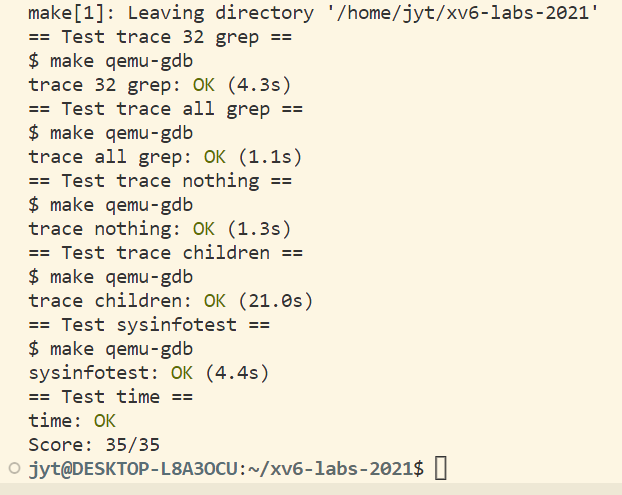
3. make grade

image-20240422214112132

4. 遗留问题

结构体在编译时可以只声明吗??

可以,不过当需要用到它的大小时,比如创建变量、sizeof 等等,就会报错(缺少信息,无法生成中间代码。
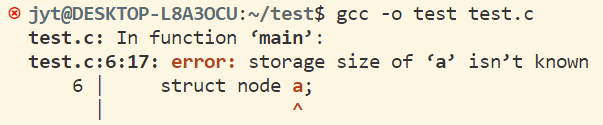
image-20240422232852951

在声明用户态的 sysinfo() 时为什么需要前向声明 struct sysinfo ?

声明指等到链接时再找到具体定义,其实就相当于 #include 所需头文件的一部分,而不是全部导入,由于允许重复声明而不允许重复定义,这样做防止直接 #include 带来的重复定义、循环依赖等问题。